Tuesday, May 19, 2015

Functions That Can Benefit from Hadoop

Apache Hadoop is 100% open source, and pioneered a fundamentally new way of storing and processing data. Instead of relying on expensive, proprietary hardware and different systems to store and process data, Hadoop enables distributed parallel processing of huge amounts of data across inexpensive, industry-standard servers that both store and process the data, and can scale without limits. With Hadoop, no data is too big. And in today’s hyper-connected world where more and more data is being created every day, Hadoop’s breakthrough advantages mean that businesses and organizations can now find value in data that was recently considered useless. One of the cost advantages of Hadoop is that because it relies in an internally redundant data structure and is deployed on industry standard servers rather than expensive specialized data storage systems, you can afford to store data not previously viable. And we all know that once data is on tape, it’s essentially the same as if it had been deleted - accessible only in extreme circumstances.
Since last decade, companies have been struggling to figure out how to deal with all of the new data that is streaming in all around them. From smartphones to production line sensors, everything is generating data. Apache Hadoop has become the go-to solution for storing and processing big data, and it provides a distinct competitive advantage for organizations across industries in several key functional areas, including security and risk management, marketing optimization, operational intelligence, the enterprise data hub, and the Internet of Things. Let’s take a closer look at these core functions that benefit from Hadoop enterprise solutions. 

Data Velocity, Data Security and Risk Management
As Data fraud, velocity and professional security breaches are becoming more frequent and typical and old fashioned security solutions just not up to the challenge of reliably protecting your company assets. Hadoop, can help your organization analyze large amounts and different types of data in real time, secure the speed of threat analysis, and improve ability to assess risk by using great machine learning models. As an example, Solutionary, a leading Managed Security Service Provider (MSSP), took their security solutions to the next level by implementing the Cisco UCS Common Platform Architecture (CPA) for Big Data with MapR. This joint solution made it possible for Solutionary to perform real-time analysis on big data in order to help protect and defend against sophisticated, and organized adversaries.

Operational Intelligence

If we want to remain competitive, we should look forward for ways to benefit our organization’s productivity and profitability. But even when it seems that our operations have been properly analyzed and optimized, we still can make subtle changes in operating environments in order to realize even greater improvement. By taking a wide variety of granular measurements from sensors, you can track patterns in operations to find new ways to optimize your organization. Cisco provides infrastructure and analytics to support Hadoop distributions such as MapR, and this type of joint solution can give you the ability to evaluate data at the speed your business demands.

Sales and Business Marketing Optimization

Current growth of social media channels which customers are using can make it seem like you’re drowning in data in an effort to better understand your customers. Hadoop can be used to cost-effectively integrate and analyze your disparate data in order to gain richer customer insights, develop personalized real-time customer relationships, and increase revenue.

Specific uses cases in sales and business marketing optimization include data analysis, audio/video advertising optimization, recommendation engine and targeting, social media analysis, and round the clock customer view. As an example many data analytics’ and business intelligence company, provides consumer insights, retail measurement, product libraries, analytics reporting, and consulting services for retail and manufacturing clients

Data Enterprise Hub
Hadoop can be used as a cost-effective data enterprise hub (DEH) to store, transform, cleanse, filter, analyze and gain new value from all kinds of data. Building a successful DEH starts with selecting the right technology in three key areas: infrastructure, a foundational system to drive DEH applications, and the data processing platform. For example, the Cisco Unified Computing System™ (Cisco UCS®) Integrated Infrastructure for Big Data can be used to reliably run your EDH. This solution delivers a highly scalable platform that is proven for enterprise applications, and can be deployed with a Hadoop distribution such as MapR, which is especially well-suited to take advantage of the compute and I/O bandwidth of Cisco UCS.Specific use cases in the EDH area include collecting raw data in a data lake, data refining, big data exploration, data warehouse optimization, and mainframe optimization.

Internet of Things
The four main areas of uses cases for the Internet of Things include personal IoT (smartphones, fitness devices), group IoT (family in a smart house, tourist group), community IoT (smart cities and roads), and industrial IoT (smart factories, retailer supply chains). The partnership between Cisco and MapR provides you with an infrastructure that can readily handle the massive amounts of real-time big data from the Internet of Things.


Reference:


Saturday, March 28, 2015

HD Video Support for Vine


Good news for users of Vine: you can now see better-looking video clips following an upgrade to the Twitter-owned six-second video service.

Vine Official Mr Mike Kaplinskiy confirmed that Vine now allow support for 720p videos.

Vine's blog post suggests that it's bumping the resolution of each video up from 480p to 720p, which is a decent improvement. Of course, the videos still look somewhat compressed so that they can be quickly loaded on mobile, but it's an important jump nonetheless. On iOS, it sounds like new Vines will immediately start uploading in high def. As for Android, you guessed it: the feature is coming "soon."
Left: 420p Right: 720p

vine compare 730x365 Vine now supports 720p HD video, update rolling out to iOS first with Android to follow

Saturday, January 31, 2015

OpenStack dominance: What to Look for in FUTURE

Openstack is a set of software tools for building and managing cloud computing platforms for public, private and hybrid clouds. Backed by some of the biggest companies in software development and hosting, as well as thousands of individual community members, many think that OpenStack is the future of cloud computing. OpenStack is managed by the OpenStack Foundation, a non-profit which oversees both development and community-building around the project.
The cloud is all about providing computing for end users in a remote environment, where the actual software runs as a service on reliable and scalable servers rather than on each end users computer. Cloud computing can refer to a lot of different things, but typically the industry talks about running different items "as a service"—software, platforms, and infrastructure. OpenStack falls into the latter category and is considered Infrastructure as a Service (IaaS). Providing infrastructure means that OpenStack makes it easy for users to quickly add new instance, upon which other cloud components can run. Typically, the infrastructure then runs a "platform" upon which a developer can create software applications which are delivered to the end users.
Open stack comprise of many different parts. Because of its open nature, anyone can add additional components to OpenStack to help it to meet their needs. Just to make some standard around OpenStack community has collaboratively identified nine key components that are a part of the "core" of OpenStack, which are distributed as a part of any OpenStack system and officially maintained by the OpenStack community.  OpenStack consists of seven core projects:
·         Compute (Nova)
·         Networking (Neutron/Quantum)
·         Identity Management (Keystone)
·         Object Storage (Swift)
·         Block Storage (Cinder)
·         Image Service (Glance)
·         User Interface Dashboard (Horizon)


·                     Nova OpenStack Compute (Nova) controls the cloud computing fabric (the core component of an infrastructure service). Written in Python, it creates an abstraction layer for virtualizing commodity server resources such as CPU, RAM, network adapters, and hard drives, with functions to improve utilization and automation.
·                      Swift OpenStack Object Storage (Swift) is based on the Rackspace Cloud Files product and is a redundant storage system ideal for scale-out storage. This makes scaling easy, as developers don’t have the worry about the capacity on a single system behind the software. It also allows the system, rather than the developer, to worry about how best to make sure that data is backed up in case of the failure of a machine or network connection.
·                     Cinder OpenStack Block Storage (Cinder) provides persistent block-level storage devices for use with OpenStack compute instances. This more traditional way of accessing files might be important in scenarios in which data access speed is the most important consideration.
·                     Neutron/Quantum Networking (Neutron), formerly called Quantum, includes the capability to manage LANs with capabilities for virtual LAN (VLAN), Dynamic Host Configuration Protocol, and Internet Protocol version 6. Users can define networks, subnets, and routers to configure their internal topology, and then allocate IP addresses and VLANs to these networks. Floating IP addresses allow users to assign (and reassign) fixed external IP addresses to the VMs.

·                     Horizon is the dashboard behind OpenStack. It is the only graphical interface to OpenStack, so for users wanting to give OpenStack a try, this may be the first component they actually “see.” Developers can access all of the components of OpenStack individually through an application programming interface (API), but the dashboard provides system administrators a look at what is going on in the cloud, and to manage it as needed.
·                     Keystone group of internal services exposed on one or many points. It provides multiple means of access, meaning developers can easily map their existing user access methods against Keystone.
·                     Glance provides image services to OpenStack. In this case, "images" refers to images (or virtual copies) of hard disks. Glance allows these images to be used as templates when deploying new virtual machine instances.
·                     Ceilometer provides telemetry services, which allow the cloud to provide billing services to individual users of the cloud. It also keeps a verifiable count of each user’s system usage of each of the various components of an OpenStack cloud. Think metering and usage reporting.
·                     Heat is the orchestration component of OpenStack, which allows developers to store the requirements of a cloud application in a file that defines what resources are necessary for that application. In this way, it helps to manage the infrastructure needed for a cloud service to run.

OpenStack dominated as top open-source Infrastructure-as-a-Service (IaaS) platform in 2014, gaining global adoption in many different industries. My prediction is that in 2015 OpenStack is going to dramatically change the Integrated System landscape. OpenStack gained significant traction in 2014 and is becoming a major platform for establishing clouds and data centers. The advantages of OpenStack are openness and higher levels of scalability and agility that address the needs of many applications. Existing Converged Systems are based on closed cloud orchestration software and thus don't provide the openness and choice that customers expect. Retrofitting Converged Systems to leverage OpenStack is not trivial and cannot meet the scalability and agility levels of Hyper-Convergence.

OpenStack vendors, meanwhile, started to see actual revenues, and many multimillion-dollar deals were publicized, as was approximately $5 billion estimated revenue expected by 2018.
As we move further into New Year 2015, key developments to watch include:
·         Attention from bigger vendors has improved confidence among larger enterprise customers. Thanks this push, the OpenStack community looked into enterprise workloads and needs, too.
·         OpenStack is expected to gain adoption at managed service providers, cloud service providers, and large enterprises that have the staff and expertise to leverage the benefits and value of OpenStack. Over time, as the OpenStack user base grows, and the eco-system solidifies and simplifies OpenStack deployments, more enterprises as well as SMBs will leverage it too.
·         More and more focus would be given to an introduction to database as a  service with an emphasis on Openstack using Trove
·         OpenStack has shifted from being a so called developer driven project to one that is more customer-friendly. OpenStack will be easier to use, manage, and scale.
·         Requirement for the common/central product management is now increasingly recognized, particularly after explosion of peripheral projects and services.  We are moving in right direction through operator- and enterprise-centric work groups.
·         Despite its pain points and deficiencies, OpenStack has the level of product maturity and features that makes it a serious option for enterprise adoption. Organizations now have more help than ever before to adopt OpenStack. We expect the adoption to grow globally along with more moving in to production.

In 2015, OpenStack stands very solid growth and its evolution will continue as the larger vendors continue building out their offerings geared at their customers’ requirements.


Tuesday, January 27, 2015

BYE BYE FLASH......YouTube now defaults to HTML5


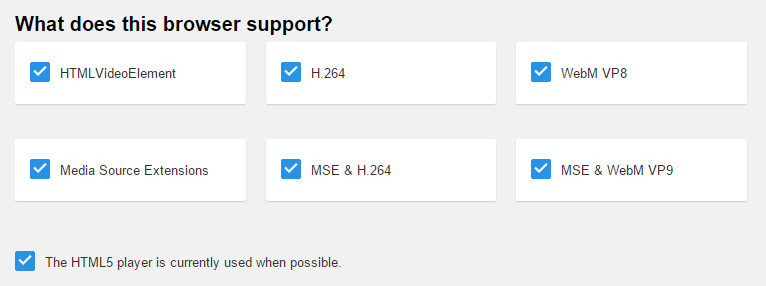
Over the last four years, YouTube have worked with browser vendors and the broader community to close those gaps, and now, YouTube uses HTML5 <video> by default in Chrome, IE 11, Safari 8 and in beta versions of Firefox.

The benefits of HTML5 extend beyond web browsers, and it's now also used in smart TVs and other streaming devices. Here are a few key technologies that have enabled this critical step forward:

By switching to HTML5, YouTube can now also make wider use of Google’s VP9 codec.
YouTube says this switch allows videos to start 15 to 80 percent faster and reduces the average bandwidth needed to stream a video by 35 percent. That may not seem like a big deal right now, but once you start streaming 4k video, that 35 percent reduction could be the difference between enjoying the video or staring at the “buffering” screen. YouTube started streaming VP9 videos in 2013 and has since served “hundreds of billions of VP9 videos.”

Now that HTML5 video is the default on YouTube, Google is deprecating its old-style <object> Flash embeds and its Flash API. YouTube recommends you only use its <iframe> embeds to embed videos going forward because that allows it to use whatever technology your visitors’ browsers support.


HTML5 video player uses a Media Source Extension feature called adaptive bitrate which adjust video quality on the fly depending on network conditions, reduced buffering by more than 50 percent globally and as much as 80 percent on heavily-congested networks.


                                2015-01-27_0939

Finally, Google is using other fancy technologies like Fullscreen APIs for immersive fullscreen viewing experience with a standard HTML interface, as well as Encrypted Media Extensions and Common Encryption for supporting multiple content protection technologies on different platforms with a single set of
assets.

Web Real-Time Communication (WebRTC), an open project for real-time voice and video communication, allows YouTube’s HTML5 video player to provide broadcasting tools from within the browser, no plugins required.


Fullscreen
Using the new fullscreen APIs in HTML5, YouTube is able to provide an immersive fullscreen viewing experience (perfect for those 4K videos), all with standard HTML UI.

These advancements have benefitted not just YouTube’s community, but the entire industry. Other content providers like Netflix and Vimeo, as well as companies like Microsoft and Apple have embraced HTML5 and been key contributors to its success. By providing an open standard platform, HTML5 has also enabled new classes of devices like Chromebooks and Chromecast. You can support HTML5 by using the <iframe> API everywhere you embed YouTube videos on the web.


Source:
Source: YouTube